

ShanghaiMay 21, 2026 /PRNewswire/ — On the afternoon of May 16, 2026, the inauguration ceremony of the Hub for Business Innovation and Globalization at emlyon business school was successfully held at the China French Chamber of Commerce. Dr. Xin Wenlong, Dean of emlyon business school Asia Campus; Dr. Zhang Weiwei, Director of the Executive Education Program; Professor Cheng Yue, Associate Professor of Operations Management; and numerous academic and industry professionals attended the event.
The Hub for Business Innovation and Globalization (BIG) at emlyon business school is a comprehensive research center dedicated to paradigm innovation in corporate globalization, aiming to achieve cross-border growth and global expansion. The center deeply integrates cutting-edge academic research, global industrial practices, and executive education empowerment, providing full lifecycle intellectual support for the internationalization process of enterprises. It serves as a core hub connecting Chinese business wisdom with global markets, helping companies achieve value leaps in global competition.
At the start of the event, Ms. Peng Peng, Deputy Director of Alumni Relations, Corporate Partnerships, and Career Services at emlyon business school Asia Campus, warmly welcomed the guests as the host. She stated that emlyon business school, as a prestigious French elite institution, has always been driven by the entrepreneurial spirit. The establishment of the Hub for Business Innovation and Globalization represents a key strategic academic move for the school and a crucial step in bridging Eastern and Western wisdom to address future uncertainties.
In his opening address, Dr. Xin Wenlong, Dean of emlyon business school Asia Campus, noted that the current global economic and trade landscape is undergoing profound transformation: rising trade frictions, frequent geopolitical conflicts, and the overseas expansion of enterprises have shifted from “market spillover” to an ultimate test of strategic resilience, geopolitical insight, and cross-cultural empathy. As an elite business school with 154 years of history and triple accreditation (EQUIS/AACSB/AMBA), emlyon has always been driven by the “entrepreneurial spirit.” The establishment of the Hub for Business Innovation and Globalization is a key step in responding to the challenges of our time—not only integrating cutting-edge academia and industrial practices but also building a global business ecosystem hub to define successful paradigms for corporate overseas expansion in a complex era. Dr. Xin Wenlong introduced that the Asia Campus has already established six research centers, including the Center for Better Business, the Eurasia Sports Industry Center, the Global HR & Organization Innovation Center, the Global AI Center, and the Global Health Industry Center. The Hub for Business Innovation and Globalization will further leverage these resources to support enterprises, ensuring that every step of globalization is deeply rooted in local contexts.
Professor Lu Jun, Director of the Hub for Business Innovation and Globalization at emlyon business school, Associate Professor of Finance, Academic Director of the EMBA program, and supervisor of the Global DBA program, explained the naming intention of the Hub for Business Innovation and Globalization (BIG) in his subsequent speech—”to make it bigger and stronger.” He stated that while emlyon’s team is strong, a larger ecosystem platform is needed to unleash its potential. The center will focus on three main directions: reconstructing international business theory, deepening regional market insights, and building bridges for industry-academia-research transformation. It aims to be more than just an academic institution; it will serve as a “super connector.” Professor Lu Jun emphasized that the center will leverage a global network of 220 partner institutions and 48,000 alumni across 130 countries to turn academic insights into practical solutions for corporate overseas expansion challenges.
In the subsequent academic sharing session, Professor Tang Yinuo from Peking University HSBC Business School and Associate Editor of the Journal of Business Research delivered a presentation on “Digitalization and Geopolitical Risks.” Using ByteDance and TikTok’s compliance challenges as examples, he pointed out that digitalization is reshaping traditional international business theories: AI and data technologies can predict consumer preferences in over 40 markets, enabling Luckin Coffee to achieve in four years what Starbucks accomplished in 20. Companies need to shift from “asset-heavy store expansion” to “asset-light digital-first” strategies and tailor differentiated approaches for enterprises with varying “digital intensity” and “geopolitical sensitivity.” He specifically noted that China has become the first country to issue regulatory rules for AI agents, stating that “institutional innovation is becoming a new moat for corporate overseas expansion.”
Professor Xing Haiyan from the Department of Sociology at Shanghai Normal University and Deputy Director-General of the UN NGO Pacific Region Education and Development Organization shared insights from an anthropological perspective on the importance of “cultural codes” in overseas expansion. Citing examples such as Walmart’s failure in Germany due to “smiling service” offending consumers and Home Depot’s struggles in China due to a mismatch with DIY culture, she remarked, “How expensive is the tuition for overseas expansion without anthropology?” She explained that anthropology, through methods like participant observation, in-depth interviews, and ethnography, can decode the cultural logic behind consumer behavior—such as the “superficially Westernized, fundamentally local” dual personality in the Philippine market, where family orientation and religious customs deeply influence purchasing decisions. Anthropology not only tells us “what was bought” but also explains “why it was bought.” She stated that the center will incorporate this perspective into its research to avoid “using Chinese logic to guess the minds of foreigners.”

During the roundtable discussion, four industry leaders with diverse expertise shared their practical experiences. Tang Yiqi, Co-founder of Star Capital, Founder of Shengdeshi Consulting, and an EMBA 2021 alumnus of emlyon business school, shared insights from the Vietnamese market: “We brought technology and capital, but our ‘efficiency-driven’ approach overlooked local rules, leading to cultural conflicts. In the future, we need to set aside pride and use local languages to gather information in bars that cannot be obtained in conference rooms.” Chen Shanshan, CEO of Shanghai Xuyuan Evolution Technology Co., Ltd. and former General Manager of the Overseas Department of China Literature Limited, recalled her experience in Kenya: “Tax authorities prioritize auditing Chinese companies with poor English skills and a lack of respect for local culture. True market insights require ‘living locally for two or three months,’ not relying on remote data guesses.” Wang Xudan, Founder of Weishi Digital Intelligence Research Institute and a DMDE alumnus of emlyon business school, used Luckin Coffee’s overseas expansion as a case study to emphasize the importance of trust reconstruction: “Luckin’s promotion of Yuanyang Latte in Hong Kong and California Sunset in the U.S. is fundamentally about ‘telling local stories.’ Now that I’ve returned to Alibaba’s Yimi Bafei Agricultural Technology, I’m trying to use transparent supply chains to solve China’s agricultural trust crisis.” Tang Bocheng, CEO of Medlink and Executive President of the Association des Anciens Élèves Français en Chine (AFEA), added: “What Southeast Asian markets lack most is not products, but trust. Medical overseas expansion needs to combine ‘high-net-worth user health management + local government-business relations + revenue-sharing models’ to avoid exposure to capital pool risks.” Professor Lu Jun concluded: “All discussions ultimately point to one word: trust. This is precisely the platform the Hub for Business Innovation and Globalization aims to build.”
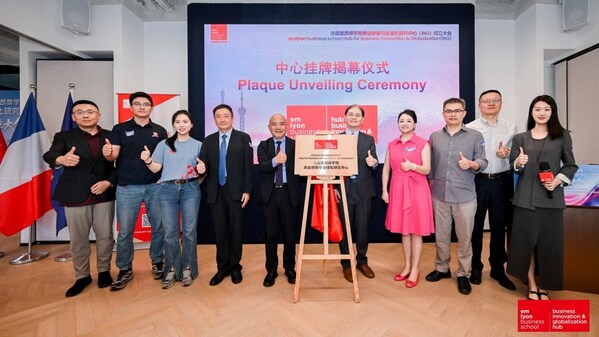
Witnessed by all guests, the event proceeded to the center’s unveiling ceremony. Dr. Xin Wenlong, Dean of emlyon business school Asia Campus, Professor Lu Jun, Director of the Hub for Business Innovation and Globalization, and other distinguished guests jointly unveiled the plaque for the Hub for Business Innovation and Globalization.
Professor Lu Jun stated on-site: “Next, we will release the ‘Global Digital Overseas Expansion White Paper,’ launch an ‘Overseas Expansion Training Camp,’ and build a ‘Local Partner’ platform leveraging alumni networks in Southeast Asia, Europe, and Africa—ensuring that every step of Chinese enterprises’ globalization is solid and sustainable.”
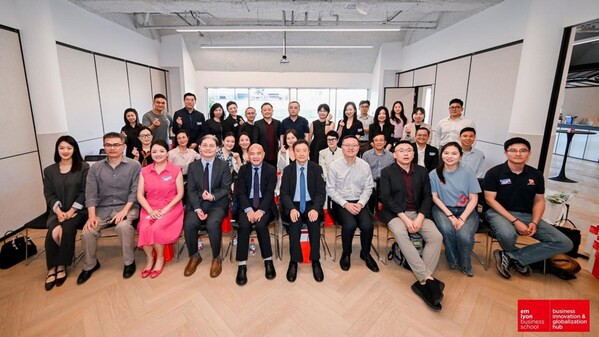
This inauguration ceremony marks the official launch of the Hub for Business Innovation and Globalization (BIG) at emlyon business school. By establishing a think tank platform spanning academia and industry, the center breaks the boundaries of traditional business research, embedding academic theory deeply into corporate overseas expansion. Looking ahead, with in-depth exchanges between industry, academia, and research, as well as deep collaboration with global alumni resources, the Hub for Business Innovation and Globalization will not only provide a strategic compass for Asian enterprises to navigate cycles but also strive to explore a Chinese-style globalization path that balances resilience and warmth amidst global business transformations.