

Ruinews Finance | Original Report
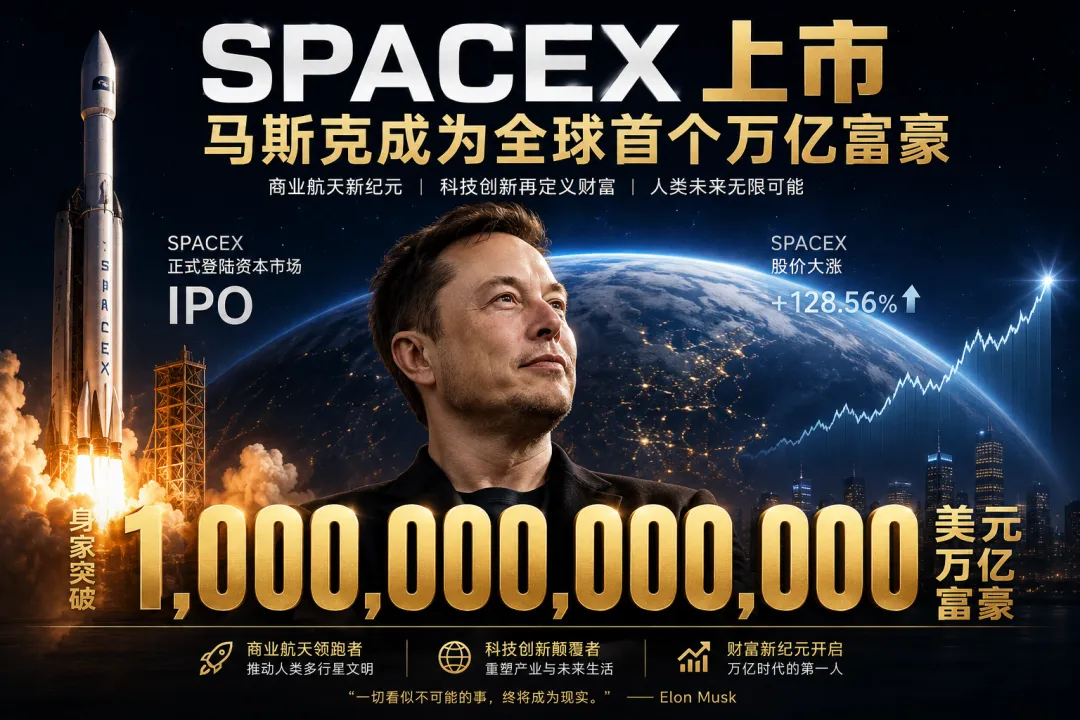
On June 12, 2026, late at night Eastern Time, the trading code “SPCX” officially lit up on the Nasdaq. Musk stood on the IPO stage, behind him a scaled-down Falcon 9 model—a detail that itself was a metaphor: real rockets never stay on Earth.
SpaceX priced its IPO at $135 per share, raising $75 billion, corresponding to a valuation of $1.77 trillion. On its first trading day, it opened at $150, surged intraday to $176.52, and closed at $160.95, up 19.22%, with a total market cap exceeding $2.1 trillion. It instantly became the sixth-largest publicly traded company in the U.S.—surpassing Tesla in market value and trailing only Nvidia. First-day total trading volume exceeded $85 billion, with global subscription demand surpassing $250 billion, oversubscribed nearly fourfold.
Musk’s personal net worth subsequently surpassed $1 trillion, making him the first “trillionaire” in human history.
This is the largest initial public offering in capitalist history, bar none.
Why It’s Hot: A Rare Asset Driven by Three Layers of Logic
SpaceX’s popularity is no accident of market sentiment; it’s the result of three layers of logic resonating simultaneously.
Layer One: A Monopolistic Technology Moat.
Reusable rocket technology is SpaceX’s strongest hand. The Falcon 9 booster has been recovered over 300 times, with a single rocket reusable more than 20 times. This technological barrier reduces launch costs for equivalent payloads to one-tenth of competitors’. As of March 2026, Starlink has launched over 10,000 operational satellites, with global paying subscribers exceeding 10 million, handling over 90% of global space-based internet traffic. In 2025, Starlink’s annual revenue surpassed $10 billion. It is currently the company’s only consistently profitable segment and the realistic anchor for its valuation.
Layer Two: Accelerating the AI Narrative.
In February 2026, Musk completed the merger of SpaceX and xAI, restructuring the combined company into three segments: aerospace, connectivity, and artificial intelligence. The prospectus pitches “orbital AI data centers”—placing GPU computing power via satellite networks into space, building AI computing infrastructure free from terrestrial power and physical constraints. In 2026, amid the valuation frenzy of Nvidia and large model companies, this narrative is highly compelling. The AI story transforms SpaceX’s market imagination from a “satellite company” to a “space operating system,” fundamentally altering its valuation multiples.
Layer Three: Forced Buying Mechanisms from Passive Funds.
S&P Dow Jones Indices is advancing rule changes that may allow ultra-large newly listed companies to be included in the S&P 500 index more quickly. Once included, passive funds tracking the index would be forced to buy SPCX according to its weight. JPMorgan warns that passive funds would then face forced rebalancing pressure, potentially requiring the market to shift nearly $950 billion in liquidity from existing tech giants to match SpaceX’s weight. This mechanism is essentially institutional price support—not driven by conviction, but by rules.
The convergence of these three layers creates a capital magnet that can hardly remain calm.
Where’s the Bubble: Three Contradictions in the Prospectus
Hype does not equal risk-free. The financial data in the prospectus directly reveals the tension between valuation and reality.
Contradiction One: A Price-to-Sales Ratio of 100x.
SpaceX’s full-year 2025 revenue was approximately $18.7 billion, with a net loss of $4.9 billion. In Q1 2026, losses widened further to $4.276 billion, with the AI segment alone posting an operating loss of $2.469 billion for the quarter. The IPO valuation of $1.77 trillion corresponds to a price-to-sales ratio exceeding 100x, several times that of Nvidia’s current P/S ratio. Nvidia is already considered a high-valuation tech stock; SpaceX’s pricing implies even more aggressive growth expectations—requiring geometric revenue and profit growth over several years to justify.
Contradiction Two: Is the AI Segment a Growth Engine or a Bottomless Pit?
Since the xAI merger, the AI segment has burned through $12.7 billion annually, spent on high-end chips and data center construction. Internal assessments describe the training performance of xAI’s computing team as “embarrassingly low,” with efforts to catch up intensifying. Sending AI data centers into space is a story with imaginative potential, but based on Q1 2026 financial data, this story is currently pure expenditure with zero revenue.
Contradiction Three: The Voting Rights Trap in Governance Structure.
Musk holds Class B shares, each with 10 times the voting power, controlling 85.1% of total voting rights. He can unilaterally decide all major matters, while retail investors’ voting power is effectively zero. Additionally, according to the lock-up schedule, the proportion of tradable shares will rise to nearly 50% by December 2026, and by June 2027, after Musk and key investors’ shares unlock, nearly 100% will be tradable—posing the largest systemic risk post-IPO. Historical data is not encouraging: star IPOs like Facebook and ARM saw concentrated selling by early shareholders after lock-up expirations, leading to significant price declines.
Goldman Sachs’ trading desk, Tony Pasquariello, offers a palliative: the total U.S. stock market cap is currently $77 trillion, and SpaceX’s $75 billion raise is equivalent to just two weeks of total shareholder dividends in the market, which can fully absorb it. But this logic overlooks a key variable: OpenAI and Anthropic are next.
Ripple Effects: Can the Market Absorb the IPO Wave of OpenAI and Anthropic?
SpaceX’s IPO is just the first baton in the 2026 super-IPO wave.
OpenAI plans to complete its IPO as early as Q4 2026, targeting a valuation of around $1 trillion. Just months ago, OpenAI completed a $122 billion private fundraising round, with a post-money valuation of $852 billion, the largest single private placement in Silicon Valley history. However, internal divisions exist: CFO Sarah Friar believes the company is not yet ready for an IPO and is cautious about the massive $600 billion capital expenditure plan over five years.
Anthropic plans to go public as soon as October 2026, raising over $60 billion, with a current valuation of approximately $380 billion. Market expectations suggest its IPO valuation could reach the $1 trillion level. Anthropic has confidentially submitted a draft S-1 to the SEC and is currently recruiting executives with experience at large publicly traded tech companies to strengthen its governance structure. Compared to OpenAI, Anthropic expects to break even by 2028, two years earlier than OpenAI—a gap that will directly impact valuation pricing.
The combined fundraising of these three companies could exceed $240 billion, all highly concentrated within the same year. This is an unprecedented liquidity stress test.
Will funds siphon away from other tech stocks?
The answer is: short-term effects are real, but long-term structural shifts are overstated.
In the short term, signals have already emerged. In the week before SpaceX’s IPO, the Philadelphia Semiconductor Index plunged over 10% due to “capital rotation expectations.” On the first trading day, most U.S. commercial space companies saw their stocks collectively plummet—funds withdrew from similar sectors to concentrate on the core target. BNP Paribas simulations show that if retail investors liquidate $1 billion in leveraged semiconductor funds, the delta effect on the options hedging side for underwriters and market makers would be amplified threefold, forcing them to sell $3 billion worth of tech stocks. This leveraged “blood-sucking” mechanism is a real short-term risk.
In the long term, mainstream institutions are relatively optimistic. Gavekal Research estimates that SpaceX, OpenAI, Anthropic, and other companies plan to raise a total of about $3.8 trillion, but this total is equivalent to roughly two months of equity financing volume in the U.S. stock market. Historical reviews show that the impact of large IPOs on the market is more “pulse-like” than “trend-like”—short-term liquidity pressure, followed by recovery as corporate fundamentals unfold.
However, one structural issue warrants attention: the IPOs of OpenAI and Anthropic will directly trigger a valuation repricing of the enterprise software sector. Anthropic’s Claude Code and Claude Cowork product lines have already caused Salesforce and ServiceNow to lose a third of their market value year-to-date, while Thomson Reuters, RELX, and other legal and financial data companies are also under pressure. This is not a liquidity competition but a business model substitution—AI-native products are fundamentally reassessing the pricing power of traditional SaaS.
The Bigger Question: Who Is Paying the Bill?
Columbia Business School professor Shivaram Rajgopal has defined 2026 as the “year of mega-IPOs” and directly warns: this may signal the peak of the bubble fueled by low interest rates and unrealistic AI expectations since the financial crisis.
This judgment is not alarmist. Looking back, during the 1999 internet bubble, 380 companies went public in the U.S. in a single year. In 2026, Goldman Sachs expects about 100 IPOs, but each individual deal size far exceeds any from 1999. The bubble’s form has changed: no longer driven by quantity, but by a few super-narratives dominating. This concentration makes the transmission path of systemic risk clearer and significantly increases the probability that “one company’s problem” becomes “a crisis of confidence for the entire theme.”
SpaceX’s Starlink is real cash flow, an asset worth pricing. xAI’s orbital data center is a technological bet that will take a decade to validate. Both are packaged into the same prospectus and issued at the same valuation—this is precisely what capital markets do best: mixing known certainty with unknown possibility into a single price.
Finally, here’s a detail retail investors most need to know: brokerages like Fidelity stipulate that retail investors who sell allocated shares within 15 to 30 days after the IPO will be flagged as “flippers” and face a permanent ban from participating in future IPOs. Once retail investors are trapped at high prices, they cannot cut losses in time. This rule is designed not to protect retail investors, but to stabilize the offering price.
Musk will not sell any shares. This is his personal public commitment. But after June 2027, his early investors have no such commitment.
Conclusion
SpaceX’s IPO is a period marking the end of an era and an exclamation point for a new one. $1.77 trillion is not just a valuation; it’s a collective promissory note for the next phase of human civilization.
The upcoming IPOs of OpenAI and Anthropic will push the total face value of this note even higher. The market will not collapse because of these companies’ existence, nor will it become smarter because they go public.
Capital is always betting on the future. The only question is: who is betting with their own money, and who is betting with others’?