

ShanghaiJune 5, 2026 /PRNewswire/ — A recent incident on a domestic expressway, where a sound barrier was ignited during a traffic accident, resulting in significant losses due to the fire, has once again drawn public attention to the safety of materials used in public facilities.
In recent years, similar sound barrier fire incidents both domestically and internationally have repeatedly sounded the alarm—such as the burning of over 600 meters of sound barrier on South Korea’s Gyeongin Expressway, and a domestic elevated road where a vehicle fire ignited the sound barrier, causing secondary hazards from molten drips. These events highlight that the flame retardancy of sound barrier materials cannot be overlooked.
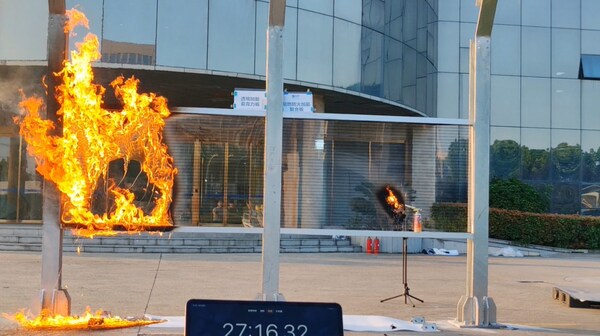
Combustion comparison test
Anatomy of a Crisis: The “Compatibility Challenge” of Material Selection
Road sound barriers are a crucial tool for urban noise control, commonly using transparent materials to meet lighting and aesthetic needs. However, this conceals a long-standing “compatibility challenge”:
- Glass materials: Once widely adopted in early years, they offer excellent flame retardancy but poor impact resistance. In the event of a collision, sharp fragments scatter, directly threatening driver and passenger safety and potentially falling onto lower roadways, causing even more severe secondary injuries.
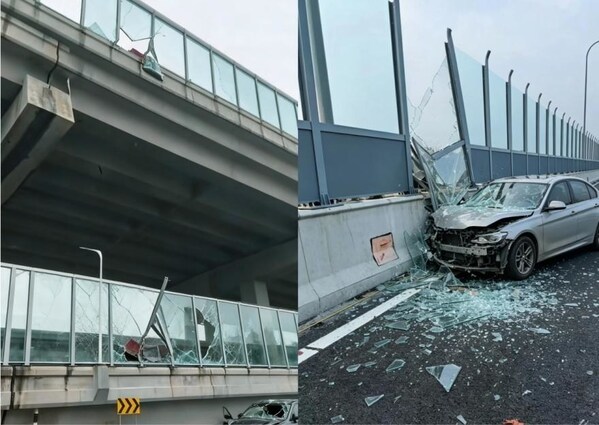
Glass materials offer excellent flame retardancy but poor impact resistance
- Common organic panels: To solve the fragility of glass, various transparent materials have emerged as new options. However, when the selected material has insufficient flame retardancy, once ignited, the flame spreads continuously, thermally decomposing to produce large amounts of flammable gases and thick smoke, further intensifying the fire. Under high temperatures, the panels soften, generating flaming drips that cause secondary combustion hazards.
Additionally, transparent materials, including glass, commonly suffer from issues like light pollution and glare, causing visual fatigue for drivers and passengers. Excessive transparency can also lead to bird collisions and fatalities.
Balancing transparency and sound insulation with impact resistance, high flame retardancy, anti-glare properties, and bird collision prevention—is this compatibility challenge truly unsolvable?
The Breakthrough: Two Decades of Dedication, A Solved Problem.
The answer is no.
For over 20 years, as a leading domestic authority and manufacturer of polymer materials for transparent sound barriers, Shanghai Pincheng has spared no effort in advancing new material safety. Collaborating with universities such as USTC and Shanghai University, the company has long been dedicated to polymer material research, publishing numerous findings in international authoritative journals and achieving industrialization in fields like rail transit interiors, industrial equipment, the low-altitude economy, and smart architecture.
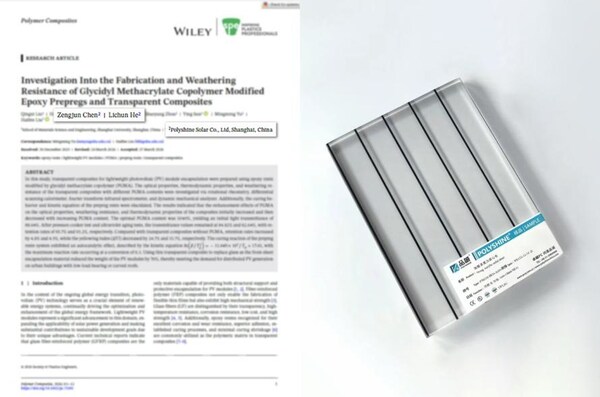
Pincheng innovatively launched the flame-retardant V0 reinforced composite panel
Pincheng not only offers B1 flame-retardant grade polycarbonate soundproof panels but also innovatively launched the 「Pincheng Flame-Retardant V0 Reinforced Composite Panel」 in 2026.
Specifically designed for road sound barriers, it not only boasts excellent aging resistance but also achieves a comprehensive breakthrough in safety performance:
Self-Extinguishing Upon Flame Removal | No Molten Dripping | Extremely Low Smoke Emission
Lightweight and Non-Shattering | Anti-Glare and Anti-Spot | Reinforced Design Prevents Bird Collisions
Realistic simulation comparison test of sound barrier panel ignition
Realistic Simulation: Tested Against 1300°C Flames, Self-Extinguishing 17 Times Repeatedly
To verify safety performance under real-world conditions, Pincheng conducted an extreme realistic simulation comparison test using standards stricter than national requirements:
A cartridge-style blowtorch with a flame temperature of up to 1300°C was used to perform extreme combustion tests on common transparent reinforced acrylic panels available on the market and Pincheng’s flame-retardant V0 reinforced composite panel.
|
Item |
Common Transparent Reinforced Acrylic |
High Weather Resistance Flame-Retardant V0 Reinforced Composite Panel |
|
Thickness |
15mm |
15mm |
|
Combustion Performance Grade |
B2(E) |
B1 |
|
Vertical Burning Test |
NG |
V0 |
|
Impact Resistance |
≥30J |
≥100J |
|
Vicat Softening Temperature |
≥100°C |
≥140°C |
|
Flame Retardancy – Limiting Oxygen Index (LOI) |
17% |
>32% |
|
Horizontal Burning Rate |
>30mm/min |
<3mm/min |
|
Vertical Burning Test |
NG |
V0 |
|
Secondary Combustion from Molten Drips |
Dripping molten material continues to burn |
Dripping solid material does not burn |
|
Decomposition of Flammable Gases and Smoke Level |
Continuously decomposes flammable gases, producing large amounts of thick smoke |
No flammable gases produced, minimal smoke |
|
Self-Extinguishing Performance Upon Flame Removal |
No |
Yes |
This 30-minute intuitive realistic simulation test is not merely a comparison of material quality; it represents a critical difference in the window of escape during a fire and the final barrier safeguarding the passage of life.
Safety Has No Room for “Good Enough”
Sound barrier safety is never simple. Once installed and used for years, it is a matter of life and death.
With quality and integrity as its foundation, Pincheng fulfills its commitment to safety through long-term rigorous validation:
- Over 20,000 hours of long-term testing
- Hundreds of tons of test materials invested annually
- Continuous enhancement of panel aging resistance, joint sealing, and wind load capacity
2. ISO 5658-2:2006 Reaction to fire tests — Spread of flame — Part 2: Lateral spread on building and transport products in vertical configuration.
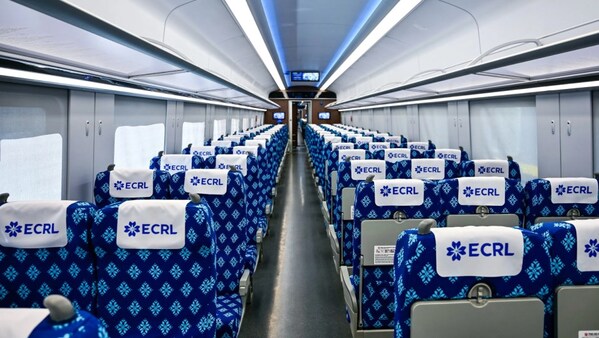
Pincheng has achieved industrialization in areas such as rail transit interiors