By Sima Chunshan | Sicong Network
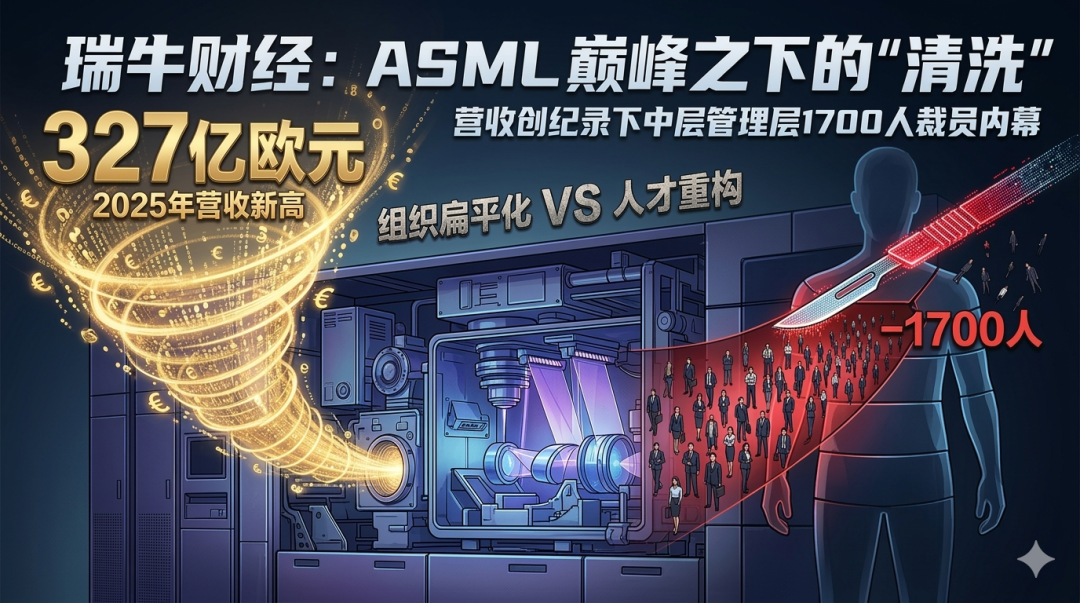
In the semiconductor equipment sector, ASML has long been regarded as a “money-printing machine” and an “everlasting giant.” However, behind its record-high revenue of 32.7 billion euros in 2025, a bloody “surgery” targeting its internal organization is unfolding.
It is reported that ASML plans to cut 1,700 management positions in its Technology and IT departments. Seven weeks after the announcement, thousands of employees who once prided themselves as the “elite middle layer” are now plunged into unprecedented anxiety and uncertainty.
1. “De-managerialization”: ASML’s Battle for Organizational Efficiency
This round of layoffs is not due to a “lack of funds,” but rather because the organization has become “too bloated.”
Internal logic breakdown: The 1,700 positions targeted by ASML are not frontline engineers, but middle-management roles (Management Positions) sandwiched between decision-makers and executors.
- Data profile: 1,400 positions are located at the Dutch headquarters, with 300 in the United States.
- Underlying intent: By cutting 4% of its managerial force, ASML aims to forcibly implement a “flattened management structure.” Against the backdrop of accelerating semiconductor technology iterations in 2026, excessive management layers are seen as hindering the feedback efficiency of core technologies like Extreme Ultraviolet (EUV) lithography.
2. “Engineering” Revival: Transfer or Departure
ASML’s spokesperson conveyed a tone of cold rationality: the company encourages these management employees to transfer to “engineering positions.”
This is essentially a “talent restructuring.” ASML’s message is clear: we no longer need as many people to “write reports, attend meetings, and manage progress”; we need engineers who can work in labs, optimize algorithms, and maintain lithography machines.
- Union pushback: The Dutch Federation of Trade Unions (FNV) has rejected the company’s proposed April 1st deadline. Union representatives bluntly stated that the timeline for this “forced transition” is highly unrealistic, and the company must first clarify the reassignment direction for affected employees.
3. Paradoxical Expansion: Shedding “Middle Layer,” Preserving “Campus”
What puzzles outsiders the most is that ASML is simultaneously “detoxifying” through layoffs while aggressively “expanding.”
- Latest development on March 11: The Eindhoven City Council approved ASML’s plan for a second Brainport campus.
- Grand vision: The campus is planned to accommodate 20,000 new employees, with the first 5,000 expected to move in by 2028.
Sicong Network analysis suggests this reflects ASML’s long-term strategic divergence: optimizing the existing management hierarchy for efficiency while stockpiling future technical manpower. Through this round of layoffs, ASML is clearing organizational debt in preparation for its “major expansion” in 2028.
4. External Pressure: The Foreshadowing of a “Shrinking” Chinese Market
Despite record revenue, ASML is not resting easy. With the continuous tightening of U.S. export controls, ASML’s revenue share from China is expected to plummet from 33% to around 20%.
Sicong Network (TechGG) Observation:
ASML’s layoffs reflect the sense of crisis felt by tech giants at their peak: when market dividends (such as market share in China) may peak and decline, internal efficiency improvement becomes the only way out.
These 1,700 managers caught in a “vacuum period of stay or go” are, in fact, the cost of the semiconductor industry’s transition from “wild growth” to “lean management.”
Dreame’s Yu Hao’s “Cosmic Ambition”: “Human, Vehicle, Home, World, Chip” – China Lifts Us Upward
Dreame’s Marvel: In-house Developed Mobile Chip “Chixiao 01” Instantly Surpasses Xiaomi’s Xuanjie?
Tencent Transforms into a “Crayfish” Giant, Market Cap Soars by 300 Billion