By Liu Huafang, “Xiao Fang Xia” · Production
While giants like Tencent, Alibaba, and ByteDance are frantically charging into AI, everyone is asking: Pinduoduo, sitting on a massive pile of cash, is neither engaging in a food delivery war nor an AI war—so what exactly does it want to do?
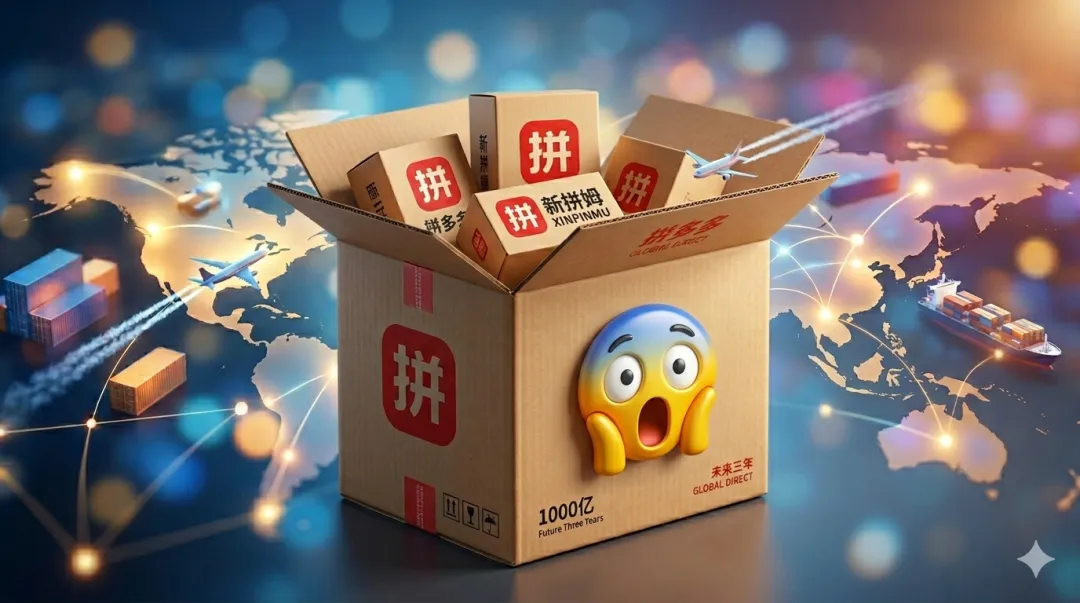
The latest financial report has sent shockwaves through the e-commerce circle. Major social platforms are buzzing about the “New Pinmu.” Some call it the “Pinduoduo version of Costco.” More precisely, “New Pinmu” is the integrated innovation of “Pinduoduo + Temu,” representing a self-transcendence of Pinduoduo’s global e-commerce resources, experience, and capabilities.
Zhao Jiazhen, Co-Chairman and Co-CEO of Pinduoduo Group, has declared: “Build another Pinduoduo in three years.” Mobilizing the entire group’s strength, the goal is to drive the “New Pinmu” strategy towards a high-quality transformation of domestic self-operated brands within three years, thereby propelling the transformation, upgrading, and value leap of China’s supply chains.
The Crucial Leap from Platform to Brand: The Temu Miracle is New Pinmu’s Confidence
The latest financial report shows Pinduoduo’s full-year 2025 revenue reached 431.8 billion yuan, a 10% year-on-year increase. However, net profit fell by 12% year-on-year to approximately 99.3 billion yuan, indicating a slowdown in growth—a result of the long-term strategy to share profits with the supply chain ecosystem.
At this juncture, Pinduoduo’s launch of the “New Pinmu” strategy, mobilizing the entire group to drive a strategic self-disruption and crucial leap from platform to brand, is an inevitable stage in Pinduoduo’s growth journey and a move that capitalizes on the right timing, location, and conditions.
The “New Pinmu” strategy has already been injected with 15 billion yuan in cash, with a planned total investment of 100 billion yuan over the next three years. It aims to integrate the supply chain resources of “Pinduoduo + Temu” and initiate the construction of a self-operated brand model. Focusing on the global market, it will systematically self-operate and incubate brands for different markets and categories, resembling a Pinduoduo version of Costco.
“New Pinmu” is not a simple business expansion. It is Pinduoduo’s strategic transformation and upgrade, actively migrating towards the higher-value end of the industrial chain, seizing a strategic window of opportunity within the global e-commerce landscape.
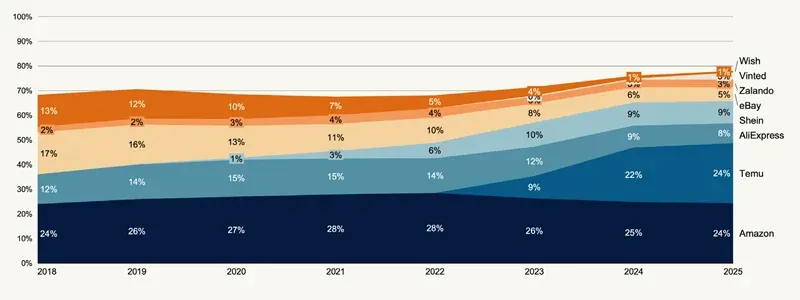
Data from the International Post Corporation (IPC)
The Temu miracle gives New Pinmu ample confidence. Within three years, Temu went from zero market share to becoming a leading player. By 2025, its cross-border e-commerce sales share reached 24%, making it one of the most commonly used cross-border platforms alongside Amazon. In contrast, traditional players are losing ground: eBay lost 68% of its cross-border share during the same period, and AliExpress also shrank by 33%.
According to various data estimates, Pinduoduo’s domestic monthly active users exceed 700 million, while Temu’s monthly active users have reached 500-600 million. Domestic user growth is nearing its ceiling, while the overseas market is in a period of high growth.
For “New Pinmu,” from day one, it possesses a super traffic gateway with a user base as high as 1.2 billion. This is a starting point any new brand dreams of and will catalyze a historic brand dividend period for China’s manufacturing supply chains.
Supply Chain Value: New Pinmu’s Deepest Moat
The “Second Evolution” of China’s Industrial Clusters
The launch of the “New Pinmu” strategy signifies Pinduoduo’s formal entry into the “deep waters” of global e-commerce. It’s not just about buying and selling goods. The core logic isn’t traffic; it’s about driving a value leap for China’s manufacturing supply chains, thereby propelling the “second evolution” of China’s industrial clusters.
The “New Pinmu” self-operated brand model is a key strategy for Pinduoduo to advance high-quality development. Its core value lies in building a more powerful flexible supply chain system, leveraging consumer data to feed back into R&D and design, achieving a paradigm shift from “production for orders” to “creation for demand.” This represents a win-win ecological evolution for both the platform and its manufacturing partners.
If consumer data is the vanguard, then supply chain value is the deepest moat. New Pinmu possesses three supply chain advantages that are difficult for others to replicate:
①Data-Manufacturing Closed Loop: Pinduoduo + Temu have accumulated consumption behavior data from hundreds of millions of users across different global markets. Which categories sell well in Europe, which styles are most popular in Southeast Asia—this data directly guides factories on what to produce and how to produce it, truly realizing “demand-driven manufacturing.”
②Comprehensive Coverage Capability of Industrial Clusters: New Pinmu plans to form specialized teams to deeply engage with industrial clusters, leveraging the platform’s digital advantages to provide merchants with integrated solutions for products, technology, and marketing, driving the improvement of manufacturing standards in these clusters. This is equivalent to digitally upgrading the entire “Yiwu Model” and then connecting it to a global sales network—something other countries simply cannot replicate.
③ Full-Chain Overseas Services: New Pinmu offers comprehensive brand globalization solutions, providing all-around services including product standards, warehousing and logistics, intellectual property services, legal assistance, and regulatory compliance. This escorts industrial clusters in their global expansion, solving the most troublesome “soft power” issues for small and medium-sized factories going overseas.
It’s not hard to imagine that “New Pinmu” will drive the rapid rise of a large number of Chinese manufacturing supply chain enterprises, bringing better self-operated brand premiums and ecological feedback, ultimately reshaping the global e-commerce ecosystem and creating a new storm.
Take the example of Shaodong, Hunan. The local area produces over 70% of the student backpacks in China but was trapped in the dilemma of “homogeneous competition” due to a long-term reliance on OEM (original equipment manufacturing) models. With Pinduoduo’s support, merchants used the platform’s data analysis for precise product development, leading to the emergence of several hit brands. This helped Shaodong complete an industrial transformation from an “OEM heartland” to a “brand highland.”
The success of Pinduoduo and Temu in domestic and international markets has proven their ability to reach consumers and integrate supply chains. Following “New Pinmu,” this will further drive the “second evolution” of China’s industrial clusters, skipping numerous operational and marketing chains to directly deliver good products to global consumers and make brands truly sell.
Building Another Pinduoduo, Reshaping the Global E-commerce Landscape
Building another Pinduoduo in three years is an exceptionally bold goal because Pinduoduo is already a super player in global e-commerce—a super e-commerce giant itself. To build another super e-commerce giant in three years is, frankly, a target most major internet companies wouldn’t dare to contemplate.
The birth of the “New Pinmu” strategy exists within a global macro-environment of consumption downgrading and inflation, where the majority of the global population has a greater need for “New Pinmu.”
Filling the Brand Vacuum: In many emerging markets (such as Latin America, Southeast Asia, Africa), consumers crave a sense of brand but have limited purchasing power. “New Pinmu” self-operated brands, with “big-brand quality at平民 prices,” can rapidly sweep through the long-tail demand in these markets, leading to very strong growth.
The Game of Package Volume vs. Value Volume: Temu’s global package share is already approaching Amazon’s, but there remains a gap in GMV (Gross Merchandise Volume). The emergence of “New Pinmu” can transform this massive order volume into higher sales value, improving ecosystem quality.
Building Another Pinduoduo: Considering there is still room for improvement in global e-commerce penetration rates and the global dominance of China’s supply chains remains solid, as long as the closed loop of “self-operated brands + global logistics” can be successfully executed, creating another growth point of equivalent GMV scale within three years is not an exaggeration and indeed possesses a high degree of certainty.
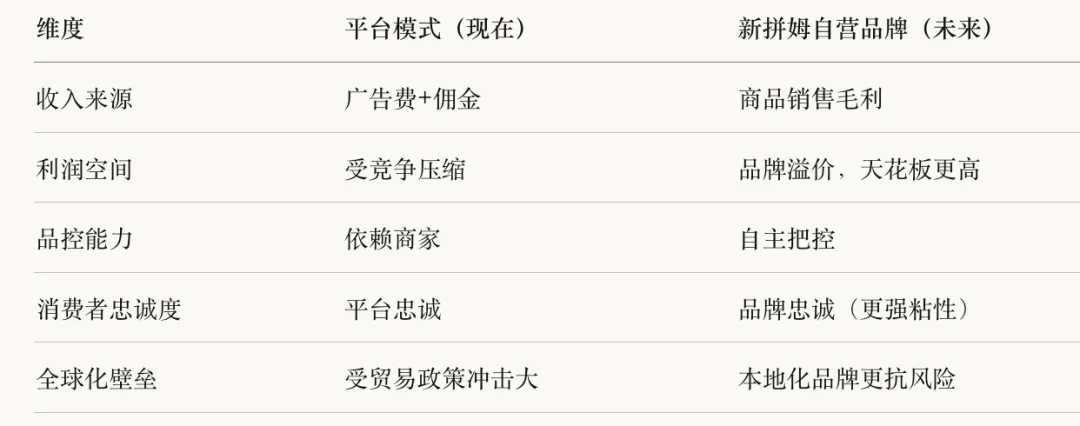
For reference, consider Amazon’s own brands (Amazon Basics). New Pinmu will inevitably significantly enhance the quality of Pinduoduo Group’s e-commerce ecosystem, leading to more competitive products and a more diversified, flexible profit model and ecological space. New Pinmu is not about creating white-label products embedded within the platform; it aims to incubate a matrix of Chinese brands with genuine global influence.
New Pinmu: A Mission of the Times, A Disruptive Leap
Not a Peripheral Experiment, But a Core Strategy with Full Commitment
Tariff pressures, RMB exchange rates, industrial relocation to Southeast Asia—these pressures are forcing Chinese manufacturing to move towards branding. New Pinmu is Pinduoduo’s disruptive leap and a product and mission of the times.
Temu is the world’s largest “testing ground,” with hundreds of millions of monthly active users distributed across dozens of countries. New brands can quickly test market reactions with extremely low A/B testing costs, and successful brands can then be scaled up.
For Chinese manufacturing merchants, “New Pinmu” is an opportunity but also a growth challenge. They need to keep pace with the platform’s strategic transformation and upgrading, seizing the opportunity to learn and evolve.
Operating a platform and incubating brands are two completely different capability systems, involving different talent, culture, and assessment mechanisms. Both Pinduoduo and its merchants need to engage in self-learning and evolution. The future path of New Pinmu is also a journey of growth and metamorphosis, breaking down consumer perception barriers while building a new order for an online version of Costco.
“Building another Pinduoduo in three years” essentially tells the supply chain, merchants, investors, and employees: “New Pinmu” is not a peripheral experiment; it is the core strategy with our full commitment.
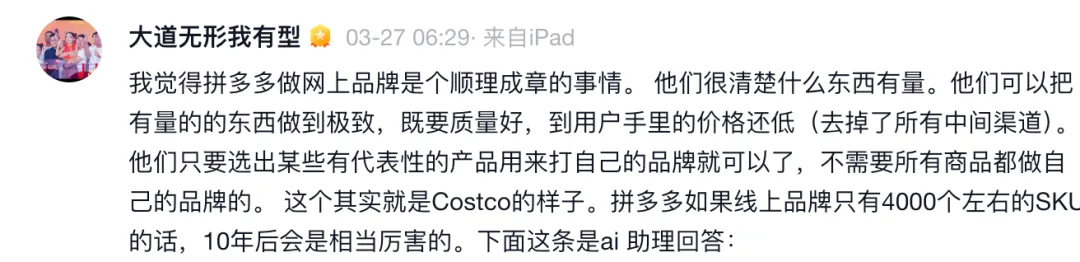
Famous investor Duan Yongping commented on “New Pinmu”: “This is essentially what Costco looks like. If Pinduoduo’s online brand only has around 4,000 SKUs, it will be quite formidable in 10 years.”
Three years to build New Pinmu, ten years of深耕 without stopping—this is a story of long-termism and a new story of reshaping the global e-commerce landscape.