

 |
TaipeiJune 3, 2026 /PRNewswire/ — On June 2, 2026, COMPUTEX 2026 officially opened in Taipei under the theme “AI Together.” This year’s exhibition showcased the trend of AI moving from data centers to diverse application scenarios, including smartphones, PCs, automobiles, robots, and various IoT terminals. During the event, TMC (德明利) unveiled its full-stack AI storage solutions, systematically addressing the new challenges that AI’s multi-scenario applications pose to storage.
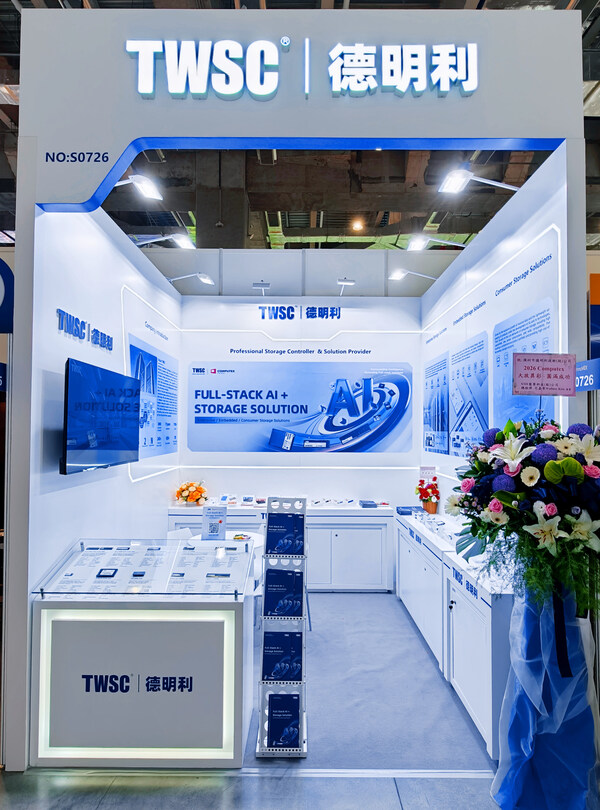
TMC Debuts at COMPUTEX 2026, Full-Stack Storage Solutions Adapt to Diverse Scenario Needs of “AI Together”
I. AI Together, Data Together
The Shift in Data’s Role: From “Storage” to “Operation”
In the past, the peak computing power of GPUs and CPUs was the core of AI systems. Today, “AI Together” means AI is shifting from single-point computing to collaborative operation across the cloud, edge, and terminal devices. The industry’s focus is no longer solely on “computing speed,” but also on how data can be efficiently stored, quickly accessed, and stably transmitted.
Current AI applications are not just about “computing,” but also about “storage.” Training data, model parameters, multimodal data, AI agent logs… the massive amounts of data generated by large models continuously drive up storage requirements: lower latency, higher concurrency, longer stable operation, and a balance between power consumption and reliability.
Therefore, the importance of storage is being re-evaluated. It is no longer just a traditional hardware component for “saving data,” but has become a fundamental capability affecting the operational efficiency of AI systems, determining whether AI “can run and run smoothly.”
II. Product Portfolio for Diverse Scenarios: Building a Collaborative AI Data Ecosystem
For Data Centers and Enterprise AI: Supporting High-Concurrency Data Access and Low Latency
Leveraging its full-stack self-developed technology system, TMC has launched an integrated enterprise storage solution from controller to module. By solidifying its technology foundation with the self-developed H3361 enterprise-grade SSD dual-mode controller, TMC offers a complete enterprise storage product solution covering PCIe/SATA SSDs and RDIMM memory modules.
- Enterprise PCIe SSD TE5133 Series: Equipped with a PCIe 5.0 high-speed interface and NVMe 1.4 protocol, relying on a domestically produced controller and proprietary firmware, it integrates full-chain enterprise-grade features such as power loss protection, atomic writes, multi-stream scheduling, Trim, and secure erase.
- Enterprise DDR5 RDIMM Memory Series: Supports speeds up to 6400MT/s, with dual protection from On-die ECC and ECC particles, along with signal anti-interference designs, providing a one-stop solution for AI computing, databases, cloud computing, and high-concurrency hot data storage scenarios.
- Enterprise SATA SSD TS3160 Series: Capacity ranges from 240GB to 3.84TB, with sequential read/write speeds up to 540/510MB/s and random read/write performance of 99K/45K IOPS, suitable for diverse scenarios like server systems and data, balancing platform compatibility and deployment efficiency.
For Smart Terminals and Personal Computing: Ensuring a Smooth Local Experience
As the demand for local model loading, on-device inference, and high-definition content processing increases, terminal devices require faster data access and more stable concurrency capabilities.
- PCIe 5.0 SSD: Sequential read/write speeds up to 14100MB/s and 12200MB/s, with capacities ranging from 1TB to 8TB. DRAM cache and DRAM-less versions cater to high-performance and thin-and-light low-power terminals respectively. Good storage energy efficiency and heat dissipation capabilities allow for easy storage and quick access to local models and massive content.
- DDR5 U/SO-DIMM Memory Modules: Support frequencies from 4800 to 7200MT/s, equipped with PMIC and On-die ECC error correction capabilities, and can also provide CKD solutions to enhance multi-tasking concurrency and operational stability in terminals.
For Embedded and Edge Devices: Balancing Low Power Consumption and High Reliability
- Embedded Storage Solution: The newly released, first mass-produced QLC NAND UFS. Leveraging the high-density characteristics of QLC, this solution offers capacities from 128GB to 1TB within the same package size, with sequential read performance 3-5 times faster than eMMC. It also provides product lines such as eMMC, UFS 3.1, and LPDDR5X, meeting requirements for small packaging, wide temperature operation, and long lifespan, providing a low-power, high-reliability foundation for edge and mobile devices.
For Mobile Storage and Customized Scenarios: Meeting Multi-Device Data Storage Needs
Targeting mobile office, image backup, and consumer electronics scenarios, TMC offers flexible customization solutions including PSSD, mUDP, UDP, and PCBA.
- S+ Series High-Endurance Storage Cards: The S+ series high-endurance storage cards are designed for long-term continuous recording scenarios such as security surveillance, vehicle dashcams, and action cameras. They support 7×24-hour stable operation and feature wide temperature operation, intelligent temperature control, and data reliability management, meeting long-term write demands in complex environments.
III. From Product Competition to System Capability Competition
For a full-scenario AI storage solution to truly support AI being “used well,” it requires not just product coverage, but also validation through real workloads and stable delivery capabilities.
Forming a Synergy of “Scale Delivery + High-End Validation” Capabilities
TMC uses the Futian base as its large-scale manufacturing and delivery center, and the Guangming base as its high-end manufacturing and validation center, forming a synergy of “scale delivery + high-end validation” capabilities to support the testing and mass production of enterprise SSDs, RDIMMs, and embedded products.
AI is redefining storage, and storage is re-entering the core of AI systems. Starting from underlying technologies, TMC supports AI’s journey from “being able to compute” to “being used well” through full-scenario system-level storage capabilities spanning R&D design, testing and validation, to intelligent manufacturing and product delivery.