

ShanghaiApril 23, 2026 /PRNewswire/ — Recently, the Phase II clinical study results of GS1-144 (also known as Gensci074), a selective neurokinin 3 receptor (NK3R) antagonist independently developed by Jinsai Pharmaceutical, a subsidiary of Changchun High-Tech, for the treatment of moderate-to-severe vasomotor symptoms (VMS, primarily hot flashes and night sweats) in postmenopausal Chinese women, were officially published in the authoritative international menopause journal Menopause. This study was led by Peking Union Medical College Hospital, Chinese Academy of Medical Sciences. This marks renewed international recognition of China’s innovative drug research capabilities in the global gynecology field, potentially offering new treatment options for menopausal patients worldwide.
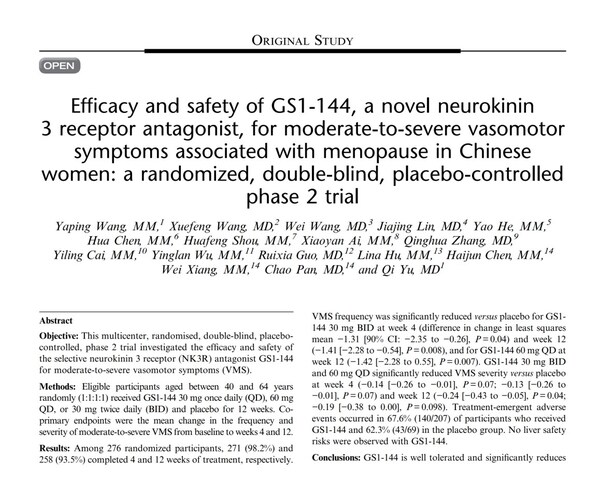
Leveraging the authoritative clinical and research expertise of Peking Union Medical College Hospital in gynecological endocrinology, along with Jinsai Pharmaceutical’s sustained investment in innovative drug R&D, a total of 276 postmenopausal women experiencing ≥7 moderate-to-severe hot flashes per day were enrolled through close collaboration across 46 clinical centers nationwide. Participants were randomly assigned to four groups: 30 mg once daily (QD), 60 mg QD, 30 mg twice daily (BID), and placebo, administered orally for 12 consecutive weeks.
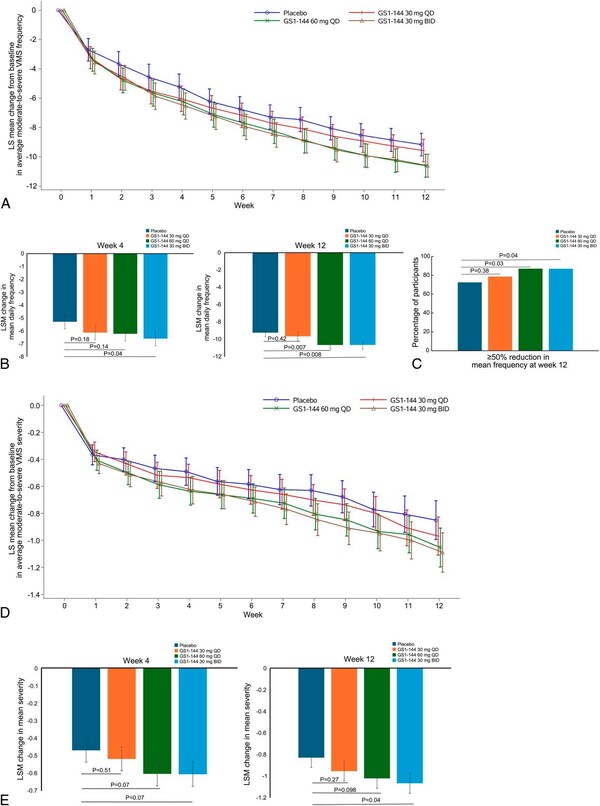
Study results showed that, compared with the placebo group, the frequency of moderate-to-severe VMS per day in the GS1-144 30 mg BID group significantly decreased from baseline at Week 4, and the 60 mg QD group also showed a notable downward trend; at Week 12, the frequency of moderate-to-severe VMS in the GS1-144 60 mg QD and GS1-144 30 mg BID groups significantly decreased from baseline (Figures A-B). At Week 12, the proportion of participants with a ≥50% reduction from baseline in moderate-to-severe VMS frequency reached 87% in both the 60 mg QD and 30 mg BID groups (Figure C), demonstrating significant clinical relevance. In terms of symptom severity, compared with the placebo group, the average daily severity of moderate-to-severe VMS in the GS1-144 60 mg QD and GS1-144 30 mg BID groups significantly decreased from baseline at Weeks 4 and 12 (Figures D-E).
Regarding safety, the incidence of treatment-emergent adverse events was similar between the GS1-144 group (67.6%) and the placebo group (62.3%), with no clear liver safety risks observed during the study period, providing an important safety basis for non-hormonal therapy.
Vasomotor symptoms are the most common symptoms in menopausal women, manifesting as hot flashes and night sweats. Approximately half of women with moderate-to-severe symptoms may experience them for 6-10 years[1,2], significantly impacting quality of life and mental health. While hormone therapy is effective, some women avoid it due to contraindications or concerns, and non-hormonal options have limited efficacy. GS1-144 holds promise as a more groundbreaking non-hormonal treatment option for this patient population.
As the principal investigator of this Phase II clinical study, Professor Yu Qi from Peking Union Medical College Hospital noted: “For postmenopausal Chinese women troubled by moderate-to-severe vasomotor symptoms like hot flashes and night sweats, the results of GS1-144 are encouraging and may redefine the Chinese standard for non-hormonal drug therapy. The data show that the drug significantly alleviates symptoms within 12 weeks, with both dosing regimens demonstrating clear statistical benefits; more importantly, it achieves a perfect balance between efficacy and safety. This study provides strong preliminary evidence, marking a critical and solid step forward for China in the field of non-hormonal menopause treatment. We look forward to the drug’s future performance, hoping it can truly help Chinese women navigate menopause safely and with ease, reshaping their quality of life.”
Women’s and children’s health is the cornerstone of public health. Jinsai Pharmaceutical has long focused on this area. Through years of strategic planning and deep cultivation, the company has built a comprehensive and multi-dimensional presence in women’s health, covering assisted reproduction, gynecological infections, common gynecological conditions, and gynecological tumors, to meet the health needs of women at different life stages. Jinsai consistently regards “hospital-enterprise collaboration” as a key R&D strategy, establishing close partnerships with top-tier tertiary hospitals in China. By leveraging the professional and technical strengths of both sides, it aims to address unmet clinical needs and jointly promote synergistic innovation in academia and industry. Currently, Jinsai Pharmaceutical has over 10 innovative pipeline assets in the women’s health field, covering common gynecological conditions such as bacterial vaginosis and endometriosis, in addition to menopausal vasomotor symptoms. It is also advancing the development of long-acting formulations in assisted reproduction, committed to providing high-quality treatment options for female patients.
References